ISO 9001:2026 Transition Guide: Gap Analysis + Free Workbook

October 30, 2026
By
Josh Peterson




There are plenty of summaries of ISO 9001:2026. For quality teams, the next question is: What do we need to do, and where should we start?
The answer depends on your quality system today. Some updated requirements may already be covered by existing processes. Others may call for clearer documentation, additional evidence, or changes to how work gets done.
To help turn that review into action, we spoke with Olivia Dattner from the ZenQMS Quality team. She is working through our internal gap assessment and planning the steps that follow, from reviewing findings with process owners to checking the results before a certification assessment.
Her approach provides a practical path for assessing the changes, assigning actions, and preparing your team for the transition.
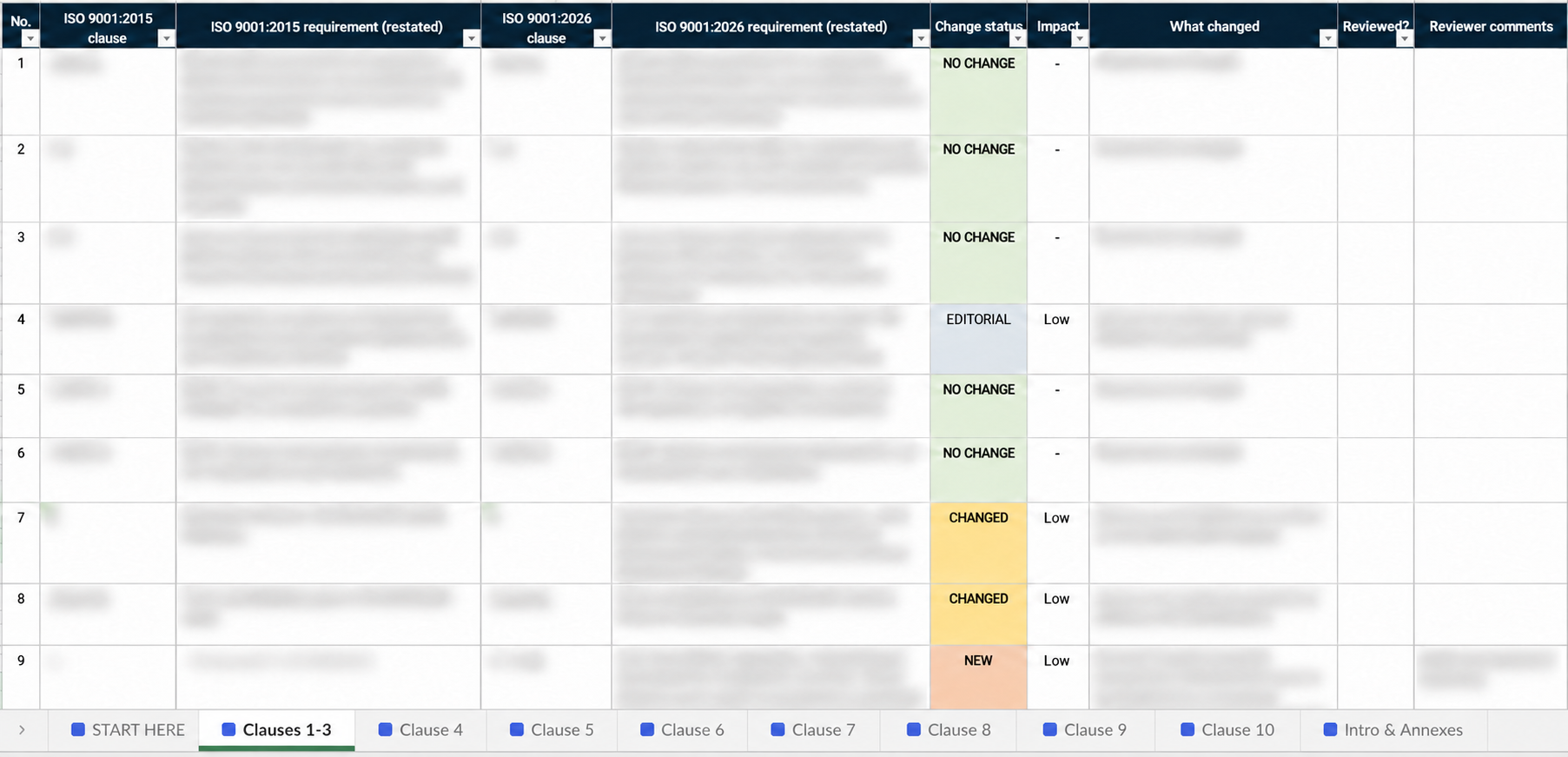
Starting your assessment? Our free ISO 9001:2026 gap analysis workbook includes clause tabs, comparison headings, and color coding to help organize your review. Use the blank template alongside your licensed copies of the standards to record requirements, findings, and assessment decisions.

What changed in ISO 9001:2026?
ISO 9001:2026 builds on the existing quality management framework. Customer focus, the process approach, risk-based thinking, and continuous improvement remain central. The revision strengthens or clarifies several areas:
ISO’s overview of ISO 9001:2026 offers more detail, while your licensed copy of the standard should guide the assessment.
Plan your ISO 9001:2026 transition around your audit schedule
Organizations certified to ISO 9001:2015 have until September 30, 2029, to complete the transition under the published transition requirements. The transition may take place during a scheduled surveillance or recertification audit, or through a separate transition audit.
Contact your certification body early. Confirm when assessments against the new edition will be available and how the transition can fit your certification cycle.
Then work backward from the assessment date. Allow time to:
- Compare requirements and assess gaps.
- Review findings and assign actions.
- Update processes, documents, and training.
- Check the results through an internal audit.
- Resolve findings before the certification assessment.
At ZenQMS, Olivia is considering our scheduled 2027 internal audit as an opportunity for an additional gap review. The aim is to fit the work into our existing quality calendar and maintain our usual certification schedule. Your schedule may look different. Give your team enough time to use updated processes and collect evidence that they work.
Start your ISO 9001:2026 gap analysis
A gap analysis, also called a gap assessment, compares your current quality system with the updated requirements to identify where action is needed.
Start by understanding the extent of the changes. Categorizing the differences helps you focus on requirements that may affect your processes and procedures.
Compare the requirements side by side
Gather your licensed standards, the applicable amendment, your previous assessment checklist, and relevant procedures and records.
Work through corresponding requirements clause by clause. Your previous assessment checklist can provide a starting point, but check it against the new edition for additions and structural changes.
Use categories to distinguish what changed:
- No change: The requirement remains the same.
- Editorial: Wording changed and needs review for meaning.
- Changed: An existing requirement was revised.
- New: A requirement was added.
- Renumbered or removed: A structural change needs to be traced and assessed.
Color coding makes the categories easier to scan and highlights areas that need closer review.
Confirm each classification before making decisions. Revised wording may affect interpretation, while a moved requirement may affect document references. If you use AI to help prepare a comparison, verify the output against your licensed standards.
Connect each change to your processes and evidence
For each relevant change, ask:
- Does an existing process address the requirement?
- Does the procedure accurately describe how the work is performed?
- What records demonstrate that the process is followed?
A new requirement may already be addressed by an established practice. Another change may reveal a gap in the process, documentation, or evidence.
Use impact ratings to prioritize the review and identify affected SOPs. Record the rationale so your team can understand and review those decisions.
Review findings with process owners
Once the initial assessment is complete, review it with Quality and the relevant process owners. For each finding, show the requirement, the affected process or SOP, and the proposed action.
Process owners can confirm how the work happens today, identify dependencies, and help determine whether the proposed change will work in practice.
Turn those decisions into specific assignments with an owner and due date. Consider related forms, responsibilities, training, and records alongside the procedure itself.
For example, one finding might require an SOP revision, an updated form, and training for the people who use both. Planning those activities together helps prevent incomplete implementation.
Manage updates through change control
With the approach agreed, manage implementation through your organization’s change control process.
The assessment findings become assigned tasks: revise documents, complete reviews and approvals, update training, and put revised processes into use.
Plan verification at the same time. Decide what evidence will demonstrate that each change was completed and achieved its intended result. Our guide to building a change control workflow explains how impact assessment, implementation, verification, and closure connect.
Keep findings linked to change records so your team can trace each requirement to the gap, agreed action, and evidence of completion.
Where changes affect how people work, include the necessary training assignments and completion tracking. Give people time to understand and apply the updated process.
An electronic quality management system (eQMS) can help connect controlled documents, training, and change records as your team works through the transition.
Use an internal audit to verify the changes
After implementation, check the updated quality system against the new requirements.
Involve a qualified reviewer who can provide an objective assessment, whether internally or through a third party. A fresh perspective can help identify anything the implementation team missed.
Follow the process into practice:
- Are people using the current procedure?
- Are the expected records available?
- Do those records demonstrate that the gap has been addressed?
Our quality audit best practices guide covers preparation steps, including clarifying process ownership and making supporting records easy to retrieve.
Allow time to resolve findings before the certification assessment. Retain evidence of the actions taken and confirm the remaining arrangements with your certification body.
Download the ISO 9001:2026 gap analysis workbook
Ready to begin your assessment?
Our free ISO 9001:2026 gap analysis workbook is based on the structure used for ZenQMS’s internal review. It includes clause tabs, comparison headings, and color coding to help your team organize its assessment.
Use the blank template alongside your licensed copies of the standards and your existing quality documentation. Add your requirements, findings, and assessment decisions, then use the results to plan actions with your team.